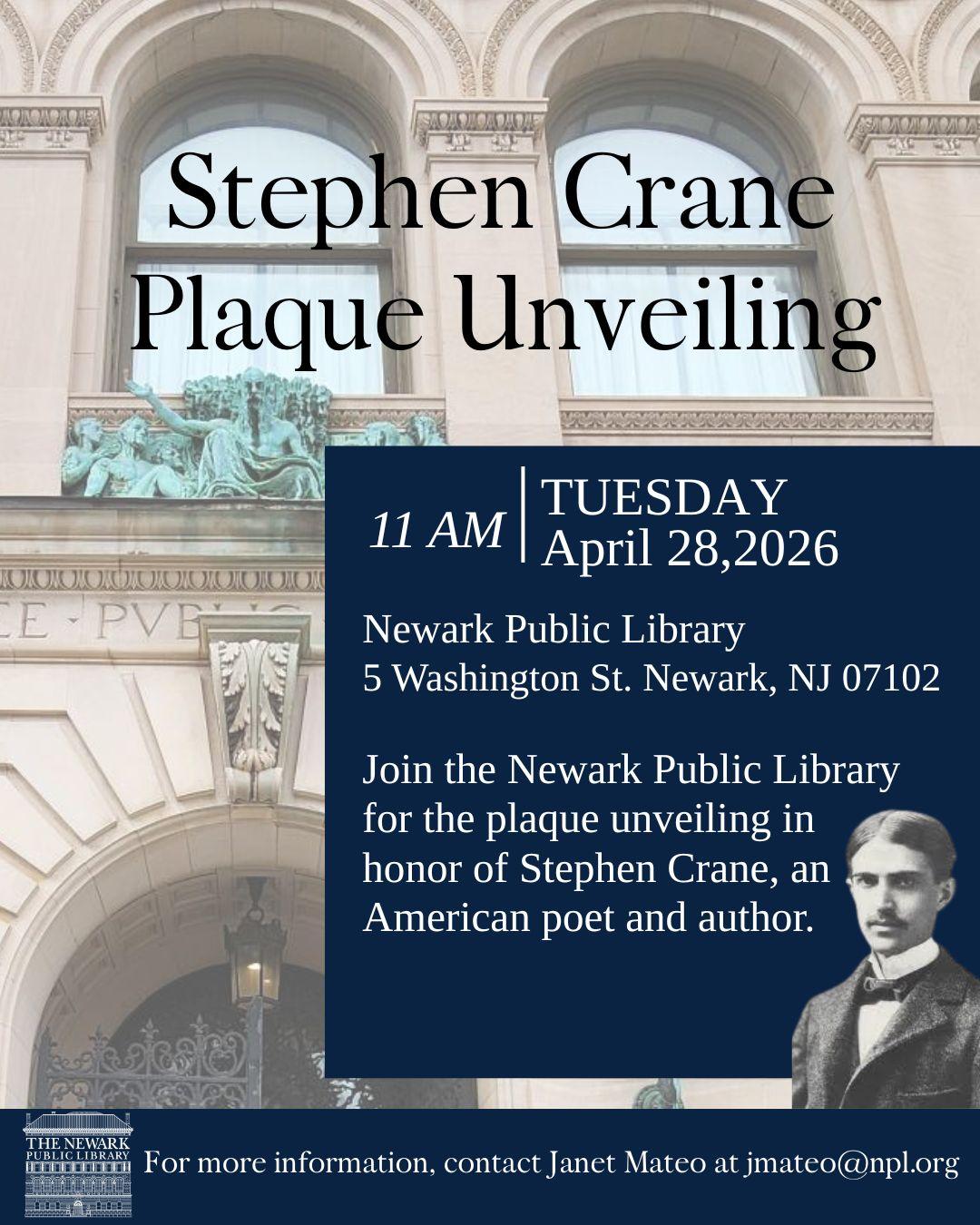
A plaque honoring Stephen Crane was recently unveiled at the Newark Public Library.
My apologies to the organizers for seeing this too late for interested parties to attend.

A plaque honoring Stephen Crane was recently unveiled at the Newark Public Library.
My apologies to the organizers for seeing this too late for interested parties to attend.

For our 2025 Fall Symposium, the American Literature Association will return to beautiful Santa Fe, New Mexico. The Drury Plaza Hotel offers an excellent location near the central plaza. Single and double rooms will be available for $209 a night plus taxes; this rate includes not only free breakfast and wireless access, but also an afternoon “kickback” every evening at 5:30 featuring hot food and cold drinks. Valet parking will be $18 per night. The conference fee of $175 includes one lunch and several receptions.
American Fiction: Forms, Genres, and Traditions: What themes, techniques, and values shape the diverse forms and traditions of American storytelling? Do aspects of the American experience encourage or privilege specific literary forms? How do American genres differ from their British or European counterparts? Do American authors work within or against established traditions? How important are certain traditions and forms: the Gothic, the Romance, Realism, Naturalism, Modernism, Post-Modernism, Experimental and Speculative fiction? What is the place of race, class, and gender in constructing, expanding, or demolishing these traditions? These and other questions should provide for a lively weekend of literary exploration and good conversation. We welcome proposals for individual papers, complete panels, and roundtable discussions on any aspect of this important subject
Please send all proposals to the conference director at
ab23@princeton.edu
as soon as possible and no later than July 15, 2025.
www.americanliteratureassociation.org
Continue readingFrom Kari Holt’s review in American Periodicals:
Reimagining Realism: A New Anthology of Late Nineteenth- & Early Twentieth-Century American Short Fiction ed. by Charles A. Johanningsmeier and Jessica E. McCarthy (review)Reimagining Realism is an exciting new anthology that provides a comprehensive and thought-provoking reassessment of Realism as a literary genre and movement within the context of the United States. Covering works published between 1863 and 1918, this anthology explores literary works across the traditional historical boundaries set for “American Realism,” but it uses these conventional boundar- ies to reimagine the genre through a new set of stories and authors that have not been included as part of the established American Realist “canon.” In doing so, the collection makes it possible to explore Realism in closer connection to American Romanticism and Sentimentalism, while also examining Realist fiction in relation to a wider range of perspectives regarding race, ethnicity, sexuality, and regional contexts, successfully illuminating the “extraordinary vitality, variety, and com- plexity” of this literary movement in ways that will spark important reconceptu- alizations of American Realist fiction (11).
Harlan Whatley has started a Substack on Stephen Crane:
Thursday, May 23, 2024 10:00-11:20 am Session 2-A
Gods, Monsters, and Hauntings in the African American Novel (Kimball) Organized by the African American Literature and Culture Society
Chair: Jean-Philippe Marcoux, Université Laval
1. “Monsters and Gods: Naturalist Racial Constructions from Stephen Crane to Richard Wright,” Justin Smith, Randolph-Macon College
2. “Translatable Gods: Reconsidering Ishmael Reed’s Mumbo Jumbo After 50 Years,” Christopher Douglas, University of Victoria
3. “Haunted Space as Representational in Kalynn Bayron’s You’re Not Supposed to Die Tonight and Vincent Tirado’s We Don’t Swim Here,” Melanie A. Marotta, Morgan State University
Session 14-B On American Literary Naturalism: Commerce, Comedy, and Uncanny Doppelgangers (Indiana)
Sponsored by the Society for the Study of American Naturalism
Chair: Eric Link, University of North Dakota
1. “Gender, Art, & Commerce in Stephen Crane’s The Third Violet.” Jennifer Moffitt, Florida Southern College
2. “Hysterical Fiction: Neurasthenic Comedy in Turn-of-the-Century Magazines.” Yair Solan, Nova Southeastern University
3. “Beyond the Divided Self: Permutations of Doubleness in Jack London’s Naturalist Speculations.” Anita Duneer, Rhode Island College
Saturday, May 25, 2024 8:30-9:50 am
Session 16-A Naturalism the Other: Immigrants, Indians, and Jews (Kimball)
Sponsored by the Society for the Study of American Naturalism
Chair: Adam H. Wood, Valdosta State University
1. “Images of Excess Consumption and the Urban Immigrant in Norris, Crane, and Dreiser,” Stephanie Batterson, Texas A&M University
2. “Not Much of a Hero: Stephen Crane, Tom Quick, and the Indian Hater Tradition,” Edward Watts, Michigan State University
3. “The Jewish Journey in Literary Naturalism.” Cara Kilgallen, Sacred Heart University
I am wondering if anyone is familiar with Crane’s Last Words, published posthumously, in England. I’ve come across a “first edition,” bound in blue cloth, while it appears that it was primarily released in maroon. I’d be grateful for any thoughts, if there are any.

Thank you, for your attention.

Sincerely,
Robert Lages
Allentown, NJ
Hello,
I would be glad if you could post it, but, to avoid the confusion, I would like to specify that the question I have is not about the ‘whine’ word ( I understand it refers to the sound of the old-fashioned streetlight), but more about the meaning of the entire sentence which is not quite clear to me. I can’t quite get the exact ‘message’ of this specific sentence and how it fits the context:
Let’s say, it would be very helpful if you or someone else could rephrase it somehow. If it is explaining why she took the lamp with her when exiting to the street, still, why is it explained not directly, but after a sentence describing how the street appeared to her? What relevance does that streetlight have to the described situation? If it explains why the street looked like that to her then she must have seen the light itself as she saw the effect it had on the crowd.
Continue readingGood morning:
Looks like Cora Crane's heir was Ernest C. Budd. Is that true? If so, did he inherit Stephen Crane's copyrights and did he pass those along to his heir?
Thanks.
Angus H. Paul
November 7-9, 2024
Drury Plaza Hotel in Santa Fe
828 Paseo de Peralta Santa Fe, NM 87501
Conference Director:
Richard Flynn, Georgia Southern University
Keynote Speaker:
Karen L. Kilcup
University of North Carolina, Greensboro
Conference Fee: $175
For our 2024 Fall Symposium, the American Literature Association will return to beautiful Santa Fe, New Mexico.The Drury Plaza Hotel offers excellent rates and is perfectly located near the central plaza. Single and double rooms will be available for $189 a night plus taxes. This rate includes not only a free breakfast and wirelessaccess, but also a “kickback” every evening at 5:30, featuring hot food and cold drinks. Valet parking will be $18 per night.
ALA symposia provide opportunities for scholars to meet in pleasant settings, present papers, and share ideasand resources. The November symposium, in cooperation with the Society for the Study of American Poetry, willfocus on American poetry. While we welcome individual proposals, panels and roundtable discussions are also encouraged.
Please send all proposals to the Conference Director at
as soon as possible and no later than September 15, 2024.
—
Ford Madox (Hueffer) Ford letters sought!
The general editors of the multi-volume Collected Letters of Ford Madox Ford for Oxford University Press would be glad to hear from anyone holding letters from (or to) Ford, or about him, or who is aware of the whereabouts of any such letters. Any relevant information will be gratefully received and acknowledged.
With thanks,
Sara Haslam (sara.haslam@open.ac.uk) and Max Saunders (m.saunders@bham.ac.uk)